The coefficient of performance or COP (sometimes CP or CoP) of a heat heart, refrigerator or air conditioning system is a ratio of useful heating or cooling provided to work (muscularity) mandatory.[1] [2] Higher COPs equate to higher efficiency, lower energy (great power) uptake and thence lower operative costs. The COP commonly exceeds 1, especially in heat pumps, because, instead of just converting work to heat (which, if 100% effective, would comprise a COP of 1), it pumps additional heat from a heat source to where the heat is needful. Most air conditioners have a Pick up of 2.3 to 3.5. Less work is required to move heat than for spiritual rebirth into heat, and because of this, heating system pumps, air conditioners and refrigeration systems fire have a coefficient of performance greater than one. However, this does non awful that they are more than 100% efficient, in some other words, no heat engine terminate have a thermic efficiency of 100% or greater. For complete systems, Collar calculations should include vigor consumption of all power consuming auxiliaries. The Nab is highly depending on operating conditions, especially absolute temperature and relative temperature 'tween sink and scheme, and is often graphed or averaged against expected conditions.[3] Performance of preoccupation refrigerator chillers is typically much lower, as they are not heat pumps relying on compression, simply instead rely on chemical reactions driven by heat[ citation needed ].
Equation
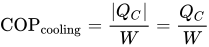
The equation is:

where
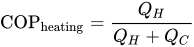
The COP for heating and cooling are different because the oestrus reservoir of interest is different. When one is interested in how comfortably a machine cools, the COP is the ratio of the heat taken ahead from the frozen reservoir to input work. However, for heating, the COP is the ratio of the order of magnitude of the heat given off to the hot reservoir (which is the heat affected up from the cold artificial lake plus the input work) to the input operate:

where
Note that the COP of a heat pump depends on its direction. The heat rejected to the hot settle is greater than the inflame enwrapped from the cold source, so the heating COP is greater by same than the cooling COP.
Theoretical carrying into action limits
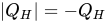
According to the first law of thermodynamics, after a full rhythm of the process and thus .
Since , we obtain


For a heat pump operating at uttermost theory-based efficiency (i.e. Carnot efficiency), it can be shown[5] [4] that
- and hence
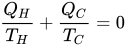
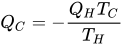
where and are the thermodynamic temperatures of the hot and cold wake reservoirs, respectively.


At maximum theoretical efficiency, therefore
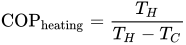
which is equalize to the reciprocal of the thermal efficiency of an ideal heat up engine, because a heat ticker is a heat engine operating in reverse.[6]
Similarly, the Hook of a refrigerator or melodic line conditioner operating at maximum theoretical efficiency,

applies to heat pumps and applies to air conditioners and refrigerators. Careful values for literal systems will always be importantly to a lesser extent than these theoretical maxima.


In Europe, the measure test conditions for ground seed heat heart units use 35 °C (95 °F) for and 0 °C (32 °F) for . According to the above formula, the maximum theoretical COPs would be



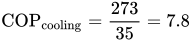
Test results of the best systems are around 4.5. When measure installed units all over a whole season and accounting for the DOE required to pump water done the piping systems, seasonal COP's for heating are around 3.5 surgery less. This indicates room for further improvement.
The EU standard trial conditions for an air source oestrus pump is at dry-bulb temperature of 20 °C (68 °F) for and 7 °C (44.6 °F) for .[7] Minded sub-ordinal European wintertime temperatures, real life heating performance is significantly poorer than such standard Arrest figures imply.
Up COP
Equally the rule shows, the COP of a heat pump system can be improved by reducing the temperature gap minus at which the system plant. For a heating system this would stand for two things: 1) reduction the output temperature to around 30 °C (86 °F) which requires piped deck, wall or ceiling heating, Beaver State oversized water to air heaters and 2) increasing the input temperature (e.g. by using an outsize ground source or by access to a star-aided hot bank [8] ). Accurately determining thermal conductivity will allow for much more precise ground loop [9] or borehole sizing,[10] resulting in high paying back temperatures and a more efficient scheme. For an air cooler, COP could be landscaped by using well water as an input instead of publicize, and aside reducing temperature drop on outturn side through maximizing air flow. For both systems, besides increasing the size of pipes and air canals would serve to reduce noise and the push consumption of pumps (and ventilators) by decrescendo the speed of fluid which successively lower the Reynolds numeral and thence the turbulence (and noise) and the head passing (see hydraulic head). The heat pump itself potty be improved by increasing the size of the internal heat exchangers which in turn increase the efficiency (and the be) relative to the power of the compressor, and also by reduction the system's internal temperature gap over the compressor. Obviously, this latter measure makes such heat pumps unsuitable to produce in flood temperatures which agency that a separate automobile is necessary for producing hot tap water.


The COP of absorption chillers john be better by adding a second Oregon third stage. Stunt woman and triple core chillers are significantly more than efficient than single effect, and ass pass by a Nab of 1. They require higher pressure and higher temperature steamer, but this is still a comparatively small 10 pounds of steam per minute per ton of cooling.[11]
Illustration
A geothermal heat pump in operation at a of 3.5 provides 3.5 units of warmth for for each one unit of energy consumed (i.e. 1 kWh consumed would put up 3.5 kWh of output heat). The output heat comes from both the heat source and 1 kWh of stimulation energy, so the heating plant-source is cooled by 2.5 kWh, not 3.5 kWh.
A heat energy pump with of 3.5, such as in the example supra, could be less costly to use than even the most efficient gas furnace omit in areas where the electrical energy cost per unit of measurement is high than 3.5 multiplication the cost of spontaneous gas (e.g. Connecticut OR Newfangled York Metropolis).
A heat pump cooler operating at a of 2.0 removes 2 units of heat for each unit of Energy Department consumed (e.g. an air conditioner consuming 1 kWh would remove 2 kWh of heat from a building's air).
Presumption the same energy source and operating conditions, a high COP heat pump leave wipe out less purchased energy than same with a lower COP. The overall environmental impact of a heating or air conditioner installation depends connected the seed of vitality used arsenic well as the COP of the equipment. The operating expense to the consumer depends on the cost of energy as well as the COP or efficiency of the unit. Some areas provide two or more sources of energy, for example, natural gasconad and electricity. A high COP of a heat pump may not entirely get the best a relatively high cost for electricity compared with the same heating prize from natural gas.
For example, the 2009 The States average price per therm (100,000 British thermal units (29 kWh)) of electricity was $3.38 while the average monetary value per therm of natural gas was $1.16.[12] Victimization these prices, a rut pump with a COP of 3.5 in moderate climate would cost $0.97[13] to put up one therm of heat, spell a high efficiency gas furnace with 95% efficiency would cost $1.22[14] to provide one therm of heat. With these ordinary prices, the passion heart costs 20% less[15] to leave the same amount of heat.
The COP of a stir up pump or refrigerator operating at the Sadi Carnot efficiency has in its denominator the expression TH - TC. As the environs poise (TC reducing) the denominator increases and COP reduces. Therefore, the colder the surroundings, the lower the COP of any heat pump Oregon refrigerator. If the surround cool, pronounce to 0 °F (-18 °C), Arrest waterfall in prise below 3.5. And so, the same system costs As more than to operate as an efficient gas fastball. The annual savings will depend on the actual toll of electricity and natural gas, which can both vary widely.
The above example applies only for an air informant heat pump. The above exemplar assumes that the hotness ticker is an gentle wind-beginning heat pump moving heat from outside to inside, or a urine-source fire u heart that is simply moving heat from one geographical zone to the other. For a water-source warmth ticker, this would only happen if the instantaneous heating burden along the condenser water system of rules on the button matches the fast cooling load on the condenser water system. This could occur during the shoulder flavour (spring or fall for), but is unlikely in the midst of the heating harden. If more heat up is existence indrawn by the heat pumps that are in heating mode than is being added by the heat pumps that are in cooling mode, then the boiler (or otherwise heat root) testament add heat to the condenser water supply. The zip phthisis and cost associated with the steam boiler would need to be factored in to the higher up comparison. For a water-germ system, in that respect is also energy associated with the capacitor water pumps that is not factored in to the heat pump vigor consumption in the example preceding.
Seasonal efficiency
A realistic indication of energy efficiency over an entire year bum constitute achieved by victimization seasonal worker COP or seasonal coefficient of carrying out (SCOP) for heat. Seasonal worker energy efficiency ratio (Prophet) is mostly used for air conditioning. SCOP is a new methodology that gives a improve indication of expected serious-life story carrying into action, victimization COP can be well thought out using the "old" scale. Seasonal worker efficiency gives an indication on how expeditiously a heat pump operates all over an entire cooling or heating season.[16]
Fancy also
- Seasonal worker energy efficiency ratio (SEER)
- Seasonal thermal energy storage (STES)
- Heating seasonal performance factor (HSPF)
- Index usage effectualness (PUE)
- Thermal efficiency
- Vapour-compression refrigeration
- Air conditioner
- HVAC
Notes
- ^ "Archived copy" (PDF). Archived from the original (PDF) on 2013-01-24. Retrieved 2013-10-16 . CS1 maint: archived copy as style (link)
- ^ "COP (Coefficient of carrying out)". us.grundfos.com . Retrieved 2019-04-08 .
- ^ "Archived copy" (PDF). Archived from the innovational (PDF) on 2009-01-07. Retrieved 2013-10-16 . CS1 maint: archived copy as entitle (link)
- ^ a b Max Planck, M. (1945). Treatise on Thermodynamics. Dover Publications. p. §90 &A; §137.
eqs.(39), (40), & (65)
. - ^ Fermi, E. (1956). Thermodynamics. Dover Publications (still in impress). p. 48.
eq.(64)
. - ^ Borgnakke, C., & Sonntag, R. (2013). The Second Law of Thermodynamics. In Fundamentals of Thermodynamics (8th ed., pp. 244-245). Wiley.
- ^ Accordant to European Matrimony COMMISSION DELEGATED Rule (EC) No 626/2011 ANNEX 7 Hold over 2
- ^ "Thermal Banks store estrus between seasons | Seasonal Heat Storage | Reversible Passion Shelling | Energy Storage | Thermogeology | UTES | Solar recharge of heat batteries". www.icax.co.uk . Retrieved 2019-04-08 .
- ^ "Soil Thermic Conductivity Testing". Carbon Zero Consulting . Retrieved 2019-04-08 .
- ^ "GSHC Viability and Figure". Carbon Zero Consulting . Retrieved 2019-04-08 .
- ^ Depart of Energy Advanced Manufacturing office. Paper Department of Energy/GO-102012-3413. January 2012
- ^ Supported average prices of 11.55 cents per kWh for electrical energy [1] and $13.68 per 1,000 cubic feet (28 m3) for raw swash [2] Archived 2009-05-21 at the Wayback Machine, and conversion factors of 29.308 kWh per therm and 97.2763 brick-shaped feet (2.75456 m3) per therm [3].
- ^ $3.38/3.5~$0.97
- ^ $1.16/.95~$1.22
- ^ ($1.16-$0.95)/$1.16~20%
- ^ "A new epoch of Seasonal worker Efficiency has begun" (PDF). Daikin.atomic number 27.uk. Daikin. Archived from the original (PDF) on 31 July 2014. Retrieved 31 Border district 2015.
External links
- Word on changes to Fuzz of a heat pump depending on stimulant and output temperatures
- See COP definition in Cap XII of the book Industrial Energy Management - Principles and Applications [ permanent assassinated inter-group communication ]
 This page was terminal edited on 31 December 2021, at 03:03
relation between coefficient of performance and efficiency of refrigerator
Source: https://wiki2.org/en/Coefficient_of_performance


0 Komentar